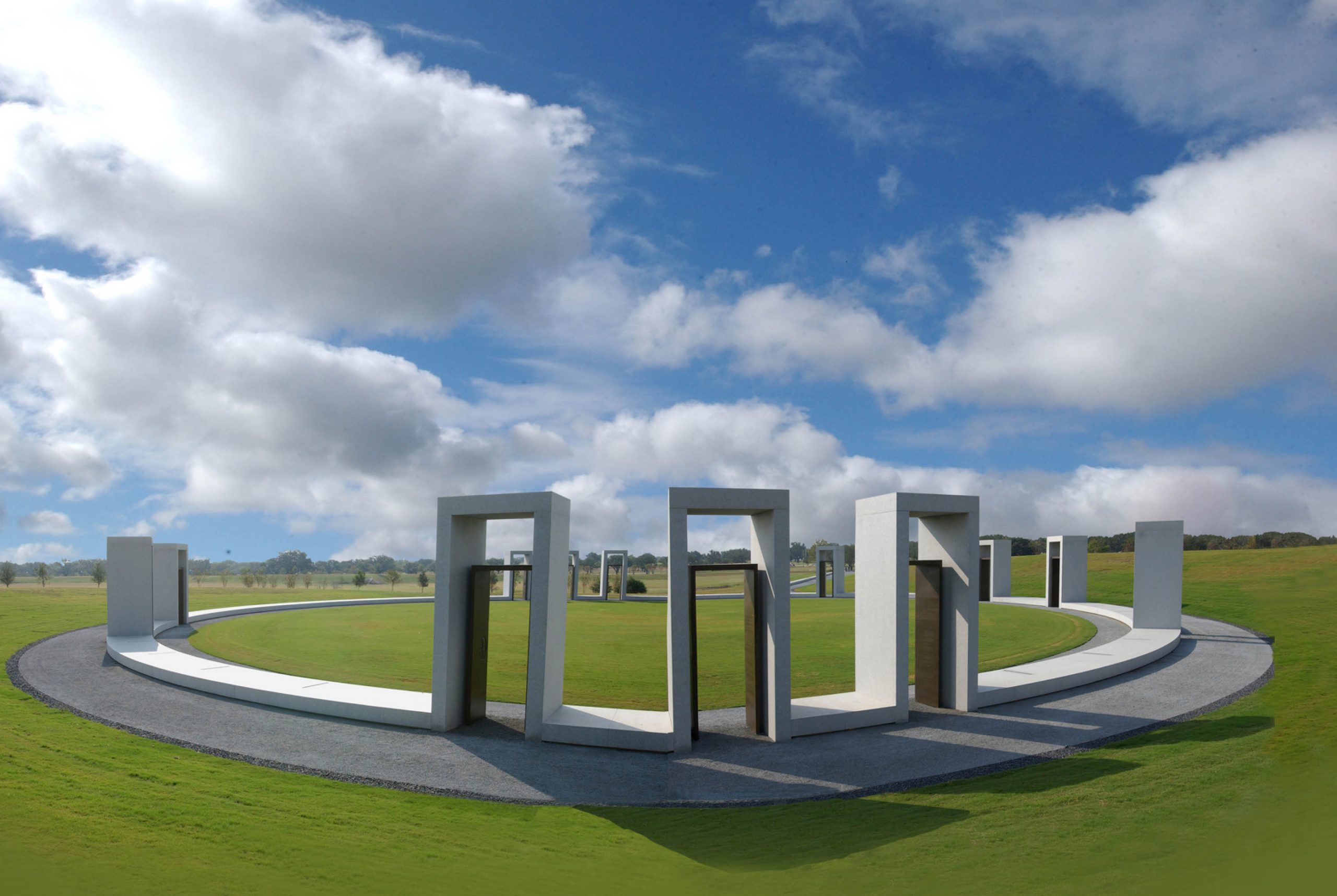
The Self-Guided Sculpture Walking Tour Brochure is available in the University Art Galleries Department office on the 6th floor of the Library Annex, by telephone at (979) 845-8501, or can be downloaded here.
The university is seeking to establish a maintainence fund to better care for its sculpture collection.
For more information on how you can support this program contact the University Art Galleries Department. 979.845.8501
Named for the Greek word for "spirit", this stainless steel sculpture stands nearly 26 feet tall, and was dedicated in 1992.
The sculptor, Hans Van de Bovenkamp of New York, explained that the two basic design elements, the ring and the wave, embody stability and endlessness. He says it stands to "remind and inspire those who pass there of their personal pursuit...the quest for a higher knowledge and state of being -- the spirit of learning."
James Earl Rudder was the sixteenth president of Texas A&M University, and his vision, leadership and commitment to excellence prompted the University's doors to be opened to women. During his distinguished military career, Major General Rudder led the charge up the cliffs of Normandy during WWII.
Ludtke, of Houston, has several other works on campus.
Donated by the Class of '91 as "a perpetual symbol of the Aggie spirit," the Victory Eagle stands 9 feet tall and has a 14 foot wingspan.
It was sculpted by Kent Ullberg of Corpus Christi. Ullberg is one of only two wildlife artists elected to membership in the National Academy of Design.
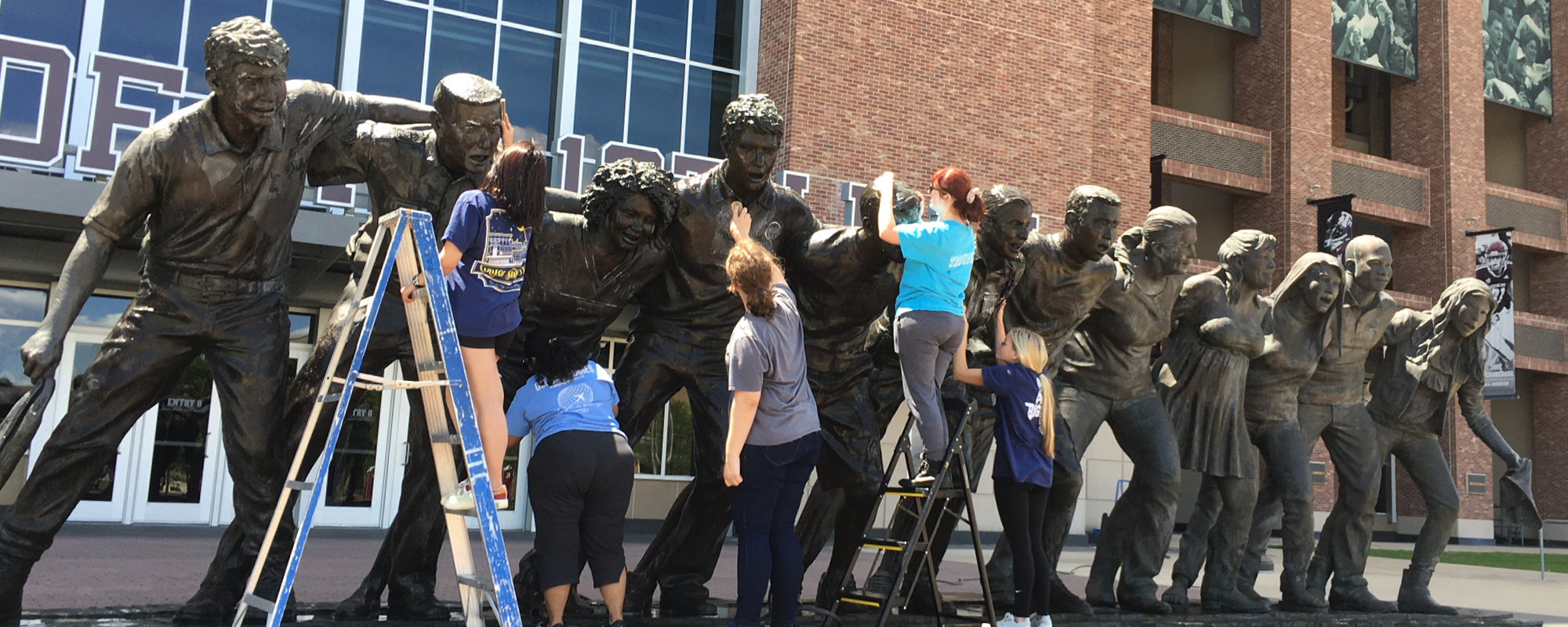
A gift of the Class of '80, this statue portrays E. King Gill, a Texas A&M football player during the 1920s. In 1922, during a post-season game, Gill was called from the stands to help the football team, which was rapidly losing players due to injuries. Although he never entered the game, by the time it was over, he was the only player standing along the sidelines. Since that game, Aggies have stood at football games to symbolize their unity with the team as its "Twelfth Man".
This life-like bronze sculpture depicting an oil field worker includes the actual chain used to control the 20-foot tall drill pipe and tri-cone rotary drill bit.
A gift of Mrs. Susan Richardson, this piece was commissioned to commemorate the ceremonial dedication of the petroleum engineering building.
This sweeping, tree-shaped sculpture, commonly known as the "Crystal Tree," is comprised of 2,500 pieces of glass.
Kebrle is a Dallas artist renowned for his stained glass work. Recent commissions include the windows of the Hard Rock Cafe in San Antonio.
This sculpture of a boy and his dog was presented to the University by Mr. & Mrs. Joe Hiram Moore in memory of their son. The title is derived from an academic class listing in the College of Architecture.
This sculpture, donated by Mrs. Helen Groves and the Kleberg family, is done in three-quarter life size.
Reno, a Western artist famous for his portraits of horses that have won the Kentucky Derby, said the statue represents an effort to portray the character of an individual who helped to win the west. Robert Justus Kleberg, Jr., was the one-time patriarch of the King Ranch.
This abstract sculpture, located near the College of Medicine, depicts a human figure with outstretched arms. The design was inspired by the quote, "Nature is the handmaiden of healing."
Smith is a retired physician from Caldwell.
This sculpture, nicknamed 'Sully' by the students, is one of the most revered works on campus. Students often place coins at Sully's feet for good luck on exams. Lawrence Sullivan Ross was a Governer of the State of Texas and the third President of the then A&M College.
Created by an A&M faculty member, this sculpture commemorates the Aggie tradition of silver taps. The silver taps ceremony is held monthly during the regular school year to honor Aggies who have died. It is a gift of the Class of 1991.
A gift of the Class of '66, this sculpture represents the stylized head of a young man emerging from a form known in mathematics as a Moebius band. This band serves as a symbol of the continuity of the Aggie Spirit. The German-born artist has been a Dallas Sculptor since 1953.
This life-sized sculpture of Lt.Gen James F Hollingsworth shows him in his Vietnam-era uniform. Hollingsworth is the most decorated general officer in the history of Texas A&M University. The base of the sculpture is inscribed with the words. "Danger 79er -- the radio call sign General Hollingsworth used for more than 20 years.
This 12 foot tall sculpture was given in honor of the College of Education's 20th anniversary. It symbolizes the teacher's role in molding and shaping the lives of students through education. Fingerprints, ranging from babies through grandmothers, impressed into the base convey the energy of Texas citizens and their hopes and dreams for the future.
This sculpture, which depicts space travel, was donated by the Albritton Engineering Company and the Reynolds Metal Company. At the time of the gift, 73 percent of the Albritton Engineering Employees who had college degrees came from Texas A&M.
Donated by the centennial Class of 1976, this eagle was dedicated to a century of excellence at the University. It is a stylized rendition of the University's centennial logo. Foley, whose son attended Texas A&M also created the Twelfth Man Statue.